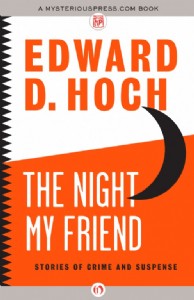
It’s been a while since I last looked at a non-series Hoch collection. That book, The Future is Ours, didn’t impress me and I’ve stuck to his series fiction since. But recently I’ve decided to really sit down and read all those various Hoch collections out there. Hence today’s book, The Night My Friend. According to editor Nevins, this “celebrates the unfamiliar side of his output,” with more of a focus on stories of crime and suspense than mystery. Though there’s plenty of that too.
The darker tone is clear from the first story, “Twilight Thunder.” During WWII, Dale Fielding and some of his fellow soldiers fragged an unpopular commanding officer. Well, to be exact, the other two fragged him, Dale didn’t do anything. Now one of his old war buddies is in town and talking blackmail. Dale hems and haws but decides there’s nothing to it but to arrange a “hunting accident”… Good story, and the ending is thematically appropriate, but I don’t know if the other man would be so willing to just walk away.
The title story introduces us to Johnny Noctune, a songwriter who sometimes rides with the cops at night, looking for inspiration. This means he’s on the scene when a young woman wearing only a coat runs up, collapses, and utters the name of Cotton Cravess, a newspaperman turned politician, before dying. Johnny is later summoned (read: kidnapped) to Cotton’s office where he gives an explanation of the girl’s death that puts him legally in the clear but would spell the doom of his campaign. So when one of the cops present when the girl died is shot to death, Johnny steps in. That being said, the mystery part is weak. Johnny’s logic boils down to “vibes.” But speaking of vibes, this has some good ones. I read this—and a lot of the other stories—late at night while in a slightly melancholic mood, and Hoch really captures the appeal of the night.
The next two stories are short ones. “The Suitcase” is a bitter-bit story about a farmer who takes a suitcase from the wreckage of a plane crash. His wife convinces him to bury it behind their barn, but he just can’t stop thinking about what could be in there…well-written, if conventional. The narrator of “The Picnic People” crashes a picnic to meet with some old friends. At first, things just seem a little off and passive-aggressive, but it soon becomes clear that our narrator hasn’t met up with these people because he’s been in an institution after killing a girl…I was worried Hoch was going to take this a dark direction. But it feels like just a vignette, part of a longer narrative that just ends. Reminds me of the stories I didn’t like from Future.
Speaking of picnics, “Day for a Picnic” is one of the few genuine mystery stories here. The narrator reminiscences about a wonderful month with his grandfather in the country, the highlight of which was the annual picnic. Well, it was a highlight for different reasons than you might expect, as a rising politician in that little town died after drinking from a poisoned mug of beer. No one could have poisoned his glass after it was poured, and others drank from the pitcher without a problem. I suspect most readers will quickly leap to both the solution and murderer, but I still liked how carefully Hoch clued it.
Speaking of clues, I was impressed with “Shattered Rainbow.” O’Bannion quits his job in a fit of anger and is stuck trolling for a new one. Meanwhile, a man named Green steals a necklace and kills a man. Obviously, destiny will bring them into each other’s paths. Green needs someone to take some “candy” over the Canadian border, and O’Bannion is feeling quite desperate. I shouldn’t have been surprised at how it all unfolded, and I was kicking myself for missing some of the hints. A good story.
Carley is “The Patient Waiter,” a man who is always waiting, waiting, waiting. He waits on customers for his job, he waits for the right chances to come along. He also waits for his clients, business owners whose businesses are failing and who need insurance money fast. This is another Hoch tale about an isolated loner wandering unknown through life, and while the ending is a bit silly, the story as a whole touched me.
“Too Long at the Fair” sees tax attorney Sam Clinton trekking up to the titular fair, which is currently in the off-season. He’s looking for a General Spindler, the head of the Noahites, an eccentric group who believe that Noah and his ark came from space. Clinton is here because the Noahites’ meeting place was written on a piece of paper in the pocket of one of his clients…who was shot and burned. Once again, I missed an obvious clue and was kicking myself for it; it elevated the story for me.
I’d first heard of “Winter Run” in a review from Mystery*File, where a comment mentioned how this story, which was first published in Alfred Hitchcock’s Mystery Magazine, it was darker than the kinds of stories Hoch tended to write for EQMM. And that was right. The protagonist, a cop, shoots a man and quits the force. He and his girlfriend go up north, where he gets a job as a security guard for a sleepy resort. It’s easy work and easy money, but he soon runs into his predecessor on the job, who was fired for sleeping with some of the ladies at the resort. And his own girlfriend is growing distant…A well-written story with a slight shock at the ending.
“The Long Way Down” is the highlight of his collection for mystery fans. Billy Calm is the mighty head of Jupiter Steel, which is heading into an advantageous merger. But something seems to be wrong with Calm. He’s late for a meeting one foggy morning, and when he does show up, he enters the directors’ meeting room and jumps out the window. His security chief, McLove, rushes to the street to find…nothing. No glass. No body. Calm has vanished into the fog. The rest of the board run around to try and resolve the financial side while McLove tries to figure out what happened to the body. Like the best of Hoch’s mystery fiction, the cluing is very well done, and the possible fake solutions are all shot down by details you see in the story. The solution is pretty good too. I have to wonder if the culprit would really come up with this plan on short notice, but it’s a clever explanation. I wasn’t super impressed with this when I read it for the New Locked Room Library, but I enjoyed it much more this time.
“Dreaming is a Lonely Thing” introduces us to Dave Krown and his girlfriend, Helen Reston. Helen isn’t brilliant or pretty (c’mon Hoch), but she does have a unique gift: She dreams, dreams of clever criminal plots and almost seems to have precognition. Dave finds this a useful gift in his line of work, but Helen is getting antsy about walking away from crime, and Dave is too much of a gambler to ever really stop. Then, during one robbery, he meets Susan Brogare, who figures out who he is and wants to meet up. She becomes fascinated by him, and soon she and Dave are meeting much more often. But Helen and her dreams, literal and figurative, are in the way. Most will see the ending coming, but it’s still a solid and dreamy (hah!) story.
“In Some Secret Place” is similar in set-up to “Day for a Picnic,” also being narrated by a young boy recounting an incident in his youth. Here, it’s the funeral for his Uncle Ben (no relation to Peter Parker), who toppled off a tractor one night and hit his head on a rock, probably while drunk. Or so it seems. The sheriff has his own ideas about what happened out there in that field. And the narrator’s Uncle Charlie has some ideas of his own. The mystery isn’t really that strong. There are some good clues but some parts of the explanation feel like the detective is just saying stuff. Still, I liked it.
“To Slay an Eagle” is a good example of Hoch’s surprisingly cynical espionage fiction. The eagle in question is the oddly named Colonel China, who’s been looting German art in the ruins of (fictional) Augshiem to fund a neo-Nazi movement. Our protagonist, Visor, has been tasked with killing him. Visor is something of an eagle himself. During the war, he led a bombing raid on Augshiem, and he exploits that experience to get close to the Colonel. The colonel’s death is a bit of an anti-climax, and you could argue that the ending is too suddenly dark.
“They Never Come Back” has a premise straight out of a Harlan Coben novel. Harry Gordon is in a violent car crash that bangs him up and leaves his wife a charred corpse. Horrible enough, but then the wife of one of his friends says that she’s alive. And then Harry thinks he sees someone like her in the city, although he’s disabused of that. And then the note arrives:“Please help me. I didn’t die in the accident.” It’s a great premise, but the final explanation is a letdown, especially since one of the clues is too obvious. (ROT13: Abeznyyl V jbhyq svaq vg naablvat, ohg urer V jbhyqa’g unir zvaqrq n fyvtug fhcreangheny nfcrpg jvgu gur sevraq’f jvsr whfg cynva frrvat n tubfg.)
“The Only Girl in His Life” sees George Granger meeting up with old friend Harold Beach. Beach has a request for George: To track down Harold’s runaway wife Linda and deliver some jewelry and clothing. George is reluctant at first but eventually decides to track this hard-to-find woman down. Good story, and the ending caught me off guard this time.
Like “Too Long at the Fair,” “It Happens, Sometimes” is set at one. This one is more active though, and protagonist Craidy—another loner—is in charge of fixing the machines at the arcade. Craidy has lived a quiet life, but this time lets himself be pulled away by the fair’s “psychic,” Rita, to watch a boxing match. But the champion throws the fight, and the newcomer is found beaten to death in an alley. In spite of the summary, this isn’t a mystery at all. There’s no doubt about what happened, it’s just the various characters deciding what to do about it. It’s not bad, but this time the bleak ending comes out of nowhere.
The narrator of “A Girl Like Cathy” runs into, well, a girl like Cathy, his ex-girlfriend, in a Greenwich Village shop. The two strike up a friendship, and before long, Laura has talked him into helping her with a job. Specifically, stealing a jeweled chalice from a rebuilt chapel. The central idea is good, but alas! Hoch used this plan as an anecdote in a Nick Velvet story, so I knew what was coming. But I don’t blame him. It’s a good idea.
“What’s It All About?” is the shortest story of the collection, about a serial hit-and-run driver. It’s a chilling picture of a psychopath that doesn’t outstay it’s welcome.
Next up is “First Offense.” This time, our hero is an angsty seventeen-year-old who spends his time at the drug store, chasing girls, and wishing he had a car so he can get out of his small town. That’s how he gets sucked into an older boy’s plan to rob some bank clerks while they’re transporting money. It’s not a bad plan, really... Hoch captures teenage ennui and naivety quite well, and the ending is good.
“Hawk in the Valley” is about another loner, this one a traveling harmonica boy who makes his way into a small town in the valley, looking for a job playing. He finds one but clashes with another player and kills him in his home, before being brought down by a single mistake.
I wasn’t sure if I’d like “The Ring with the Velvet Ropes,” but it was actually one of my favorites from the collection. Jim Figg is a boxer on the verge of becoming the heavyweight champion of the world. He sallies forth, uncaring about the rumors of the real champion, Roderik Blanco. Turns out that Blanco is very real. His men kidnap Jim and bring him to Blanco’s mansion. Blanco is a rich man obsessed with boxing, but he’ll lose his trust fund if he’s ever caught fighting. So he has a boxing ring in his home and makes a habit of duking it out with the latest champion. He’s never lost yet, but Jim can take him. Of course, Blanco might not take defeat well…While I think the way Jim gets out of this mess is weak—there’s no way Blanco would go for it or accept defeat like that—I really enjoyed this story. It’s just so weird that I can’t help but like this very unusual thriller.
The collection ends with “Homecoming,” where the old boys—those that survived the war, anyway—come back to their old high school. Most of them haven’t done great things in their lives, but Mark Wedmer has. The perpetual victim of bullying, he’s become a big-name Wall Street man now, and he wants to make sure everyone knows it. His bullies certainly take notice. A downer ending for a downer collection.
While the mystery content is pretty minimal, I actually enjoyed The Night My Friend. Part of it was my mindset while reading. Like I said, Hoch was fascinated by loners—good and bad—who thrive best in the night. As a loner who enjoys the night myself, I was often drawn into these stories and their melancholia. While I wouldn’t recommend this for those who care about the mystery and nothing but the mystery, for anyone who wants to walk in the sometimes gentle, sometimes bleak night, this is well worth your time. Recommended.
The title story introduces us to Johnny Noctune, a songwriter who sometimes rides with the cops at night, looking for inspiration. This means he’s on the scene when a young woman wearing only a coat runs up, collapses, and utters the name of Cotton Cravess, a newspaperman turned politician, before dying. Johnny is later summoned (read: kidnapped) to Cotton’s office where he gives an explanation of the girl’s death that puts him legally in the clear but would spell the doom of his campaign. So when one of the cops present when the girl died is shot to death, Johnny steps in. That being said, the mystery part is weak. Johnny’s logic boils down to “vibes.” But speaking of vibes, this has some good ones. I read this—and a lot of the other stories—late at night while in a slightly melancholic mood, and Hoch really captures the appeal of the night.
The next two stories are short ones. “The Suitcase” is a bitter-bit story about a farmer who takes a suitcase from the wreckage of a plane crash. His wife convinces him to bury it behind their barn, but he just can’t stop thinking about what could be in there…well-written, if conventional. The narrator of “The Picnic People” crashes a picnic to meet with some old friends. At first, things just seem a little off and passive-aggressive, but it soon becomes clear that our narrator hasn’t met up with these people because he’s been in an institution after killing a girl…I was worried Hoch was going to take this a dark direction. But it feels like just a vignette, part of a longer narrative that just ends. Reminds me of the stories I didn’t like from Future.
Speaking of picnics, “Day for a Picnic” is one of the few genuine mystery stories here. The narrator reminiscences about a wonderful month with his grandfather in the country, the highlight of which was the annual picnic. Well, it was a highlight for different reasons than you might expect, as a rising politician in that little town died after drinking from a poisoned mug of beer. No one could have poisoned his glass after it was poured, and others drank from the pitcher without a problem. I suspect most readers will quickly leap to both the solution and murderer, but I still liked how carefully Hoch clued it.
Speaking of clues, I was impressed with “Shattered Rainbow.” O’Bannion quits his job in a fit of anger and is stuck trolling for a new one. Meanwhile, a man named Green steals a necklace and kills a man. Obviously, destiny will bring them into each other’s paths. Green needs someone to take some “candy” over the Canadian border, and O’Bannion is feeling quite desperate. I shouldn’t have been surprised at how it all unfolded, and I was kicking myself for missing some of the hints. A good story.
Carley is “The Patient Waiter,” a man who is always waiting, waiting, waiting. He waits on customers for his job, he waits for the right chances to come along. He also waits for his clients, business owners whose businesses are failing and who need insurance money fast. This is another Hoch tale about an isolated loner wandering unknown through life, and while the ending is a bit silly, the story as a whole touched me.
“Too Long at the Fair” sees tax attorney Sam Clinton trekking up to the titular fair, which is currently in the off-season. He’s looking for a General Spindler, the head of the Noahites, an eccentric group who believe that Noah and his ark came from space. Clinton is here because the Noahites’ meeting place was written on a piece of paper in the pocket of one of his clients…who was shot and burned. Once again, I missed an obvious clue and was kicking myself for it; it elevated the story for me.
I’d first heard of “Winter Run” in a review from Mystery*File, where a comment mentioned how this story, which was first published in Alfred Hitchcock’s Mystery Magazine, it was darker than the kinds of stories Hoch tended to write for EQMM. And that was right. The protagonist, a cop, shoots a man and quits the force. He and his girlfriend go up north, where he gets a job as a security guard for a sleepy resort. It’s easy work and easy money, but he soon runs into his predecessor on the job, who was fired for sleeping with some of the ladies at the resort. And his own girlfriend is growing distant…A well-written story with a slight shock at the ending.
“The Long Way Down” is the highlight of his collection for mystery fans. Billy Calm is the mighty head of Jupiter Steel, which is heading into an advantageous merger. But something seems to be wrong with Calm. He’s late for a meeting one foggy morning, and when he does show up, he enters the directors’ meeting room and jumps out the window. His security chief, McLove, rushes to the street to find…nothing. No glass. No body. Calm has vanished into the fog. The rest of the board run around to try and resolve the financial side while McLove tries to figure out what happened to the body. Like the best of Hoch’s mystery fiction, the cluing is very well done, and the possible fake solutions are all shot down by details you see in the story. The solution is pretty good too. I have to wonder if the culprit would really come up with this plan on short notice, but it’s a clever explanation. I wasn’t super impressed with this when I read it for the New Locked Room Library, but I enjoyed it much more this time.
“Dreaming is a Lonely Thing” introduces us to Dave Krown and his girlfriend, Helen Reston. Helen isn’t brilliant or pretty (c’mon Hoch), but she does have a unique gift: She dreams, dreams of clever criminal plots and almost seems to have precognition. Dave finds this a useful gift in his line of work, but Helen is getting antsy about walking away from crime, and Dave is too much of a gambler to ever really stop. Then, during one robbery, he meets Susan Brogare, who figures out who he is and wants to meet up. She becomes fascinated by him, and soon she and Dave are meeting much more often. But Helen and her dreams, literal and figurative, are in the way. Most will see the ending coming, but it’s still a solid and dreamy (hah!) story.
“In Some Secret Place” is similar in set-up to “Day for a Picnic,” also being narrated by a young boy recounting an incident in his youth. Here, it’s the funeral for his Uncle Ben (no relation to Peter Parker), who toppled off a tractor one night and hit his head on a rock, probably while drunk. Or so it seems. The sheriff has his own ideas about what happened out there in that field. And the narrator’s Uncle Charlie has some ideas of his own. The mystery isn’t really that strong. There are some good clues but some parts of the explanation feel like the detective is just saying stuff. Still, I liked it.
“To Slay an Eagle” is a good example of Hoch’s surprisingly cynical espionage fiction. The eagle in question is the oddly named Colonel China, who’s been looting German art in the ruins of (fictional) Augshiem to fund a neo-Nazi movement. Our protagonist, Visor, has been tasked with killing him. Visor is something of an eagle himself. During the war, he led a bombing raid on Augshiem, and he exploits that experience to get close to the Colonel. The colonel’s death is a bit of an anti-climax, and you could argue that the ending is too suddenly dark.
“They Never Come Back” has a premise straight out of a Harlan Coben novel. Harry Gordon is in a violent car crash that bangs him up and leaves his wife a charred corpse. Horrible enough, but then the wife of one of his friends says that she’s alive. And then Harry thinks he sees someone like her in the city, although he’s disabused of that. And then the note arrives:“Please help me. I didn’t die in the accident.” It’s a great premise, but the final explanation is a letdown, especially since one of the clues is too obvious. (ROT13: Abeznyyl V jbhyq svaq vg naablvat, ohg urer V jbhyqa’g unir zvaqrq n fyvtug fhcreangheny nfcrpg jvgu gur sevraq’f jvsr whfg cynva frrvat n tubfg.)
“The Only Girl in His Life” sees George Granger meeting up with old friend Harold Beach. Beach has a request for George: To track down Harold’s runaway wife Linda and deliver some jewelry and clothing. George is reluctant at first but eventually decides to track this hard-to-find woman down. Good story, and the ending caught me off guard this time.
Like “Too Long at the Fair,” “It Happens, Sometimes” is set at one. This one is more active though, and protagonist Craidy—another loner—is in charge of fixing the machines at the arcade. Craidy has lived a quiet life, but this time lets himself be pulled away by the fair’s “psychic,” Rita, to watch a boxing match. But the champion throws the fight, and the newcomer is found beaten to death in an alley. In spite of the summary, this isn’t a mystery at all. There’s no doubt about what happened, it’s just the various characters deciding what to do about it. It’s not bad, but this time the bleak ending comes out of nowhere.
The narrator of “A Girl Like Cathy” runs into, well, a girl like Cathy, his ex-girlfriend, in a Greenwich Village shop. The two strike up a friendship, and before long, Laura has talked him into helping her with a job. Specifically, stealing a jeweled chalice from a rebuilt chapel. The central idea is good, but alas! Hoch used this plan as an anecdote in a Nick Velvet story, so I knew what was coming. But I don’t blame him. It’s a good idea.
“What’s It All About?” is the shortest story of the collection, about a serial hit-and-run driver. It’s a chilling picture of a psychopath that doesn’t outstay it’s welcome.
Next up is “First Offense.” This time, our hero is an angsty seventeen-year-old who spends his time at the drug store, chasing girls, and wishing he had a car so he can get out of his small town. That’s how he gets sucked into an older boy’s plan to rob some bank clerks while they’re transporting money. It’s not a bad plan, really... Hoch captures teenage ennui and naivety quite well, and the ending is good.
“Hawk in the Valley” is about another loner, this one a traveling harmonica boy who makes his way into a small town in the valley, looking for a job playing. He finds one but clashes with another player and kills him in his home, before being brought down by a single mistake.
I wasn’t sure if I’d like “The Ring with the Velvet Ropes,” but it was actually one of my favorites from the collection. Jim Figg is a boxer on the verge of becoming the heavyweight champion of the world. He sallies forth, uncaring about the rumors of the real champion, Roderik Blanco. Turns out that Blanco is very real. His men kidnap Jim and bring him to Blanco’s mansion. Blanco is a rich man obsessed with boxing, but he’ll lose his trust fund if he’s ever caught fighting. So he has a boxing ring in his home and makes a habit of duking it out with the latest champion. He’s never lost yet, but Jim can take him. Of course, Blanco might not take defeat well…While I think the way Jim gets out of this mess is weak—there’s no way Blanco would go for it or accept defeat like that—I really enjoyed this story. It’s just so weird that I can’t help but like this very unusual thriller.
The collection ends with “Homecoming,” where the old boys—those that survived the war, anyway—come back to their old high school. Most of them haven’t done great things in their lives, but Mark Wedmer has. The perpetual victim of bullying, he’s become a big-name Wall Street man now, and he wants to make sure everyone knows it. His bullies certainly take notice. A downer ending for a downer collection.
While the mystery content is pretty minimal, I actually enjoyed The Night My Friend. Part of it was my mindset while reading. Like I said, Hoch was fascinated by loners—good and bad—who thrive best in the night. As a loner who enjoys the night myself, I was often drawn into these stories and their melancholia. While I wouldn’t recommend this for those who care about the mystery and nothing but the mystery, for anyone who wants to walk in the sometimes gentle, sometimes bleak night, this is well worth your time. Recommended.

No comments:
Post a Comment