In the year 1994, Hiroshi MORI (I swear he wants his name written like that), wrote The Perfect Insider, which got quite a bit of attention as a scientific detective novel. In Japan. In the West it was an unknown, as expected. In Japan, it was the start of the oddly named S&M series, starring architecture professor Sohei Saikawa and his student Moe Nishinosono. Oddly enough architecture plays almost no role in the stories.) Each episode is a two-parter adapting one of the original novels.Sunday, December 31, 2017
Inside Edition
In the year 1994, Hiroshi MORI (I swear he wants his name written like that), wrote The Perfect Insider, which got quite a bit of attention as a scientific detective novel. In Japan. In the West it was an unknown, as expected. In Japan, it was the start of the oddly named S&M series, starring architecture professor Sohei Saikawa and his student Moe Nishinosono. Oddly enough architecture plays almost no role in the stories.) Each episode is a two-parter adapting one of the original novels.Thursday, December 21, 2017
Ace Attorney Retrospective: Reunion, and Turnabout
A while back, I said I intended to do a retrospective of the Ace Attorney series. Needless to say, this plan faltered when I realized the sheer number of hours I’d have to contribute to it. That doesn’t mean I can’t ramble about one of the most important moments in my mystery obsession. So this will more nostalgia than an actual review.The second game in the series, Phoenix Wright: Ace Attorney: Justice For All, is considered by many fans to be one of the weaker games in the series for a multitude of reasons., such as weaker mysteries and a lack of an overarching plot connecting the cases. However, it was my intro to this amazing series, so I can forgive a fair amount. Especially when I consider the role this played in my love of mysteries.
The second case of the game, Reunion and Turnabout, opens with Phoenix Wright’s office being invaded by Dr. Turner Grey, who has an unusual request for the attorney. Two years ago, Grey’s clinic went through a double round of controversy. A nurse mixed up medications, resulting in the deaths of fourteen patients. Shortly after, she died in a fiery car accident. Allegations began to spread that Dr. Grey may have overworked the nurse in the first place, then drugged her to get rid of her in the accident. The good doctor’s plan to clear his name is an idea that’s only plausible in the Ace Attorney world: Spirit channeling.
Grey’s plan is to have the nurse channelled and get a signed confession from her, admitting her full fault about the incidents. Phoenix isn’t sure why he’s needed for this, but then Dr. Grey mentions who the channeller is: Maya Fey, Phoenix’s assistant who returned to her home village at the end of the fourth case of the previous game. She wants Phoenix to accompany Grey before she does any channeling, and Phoenix eagerly agrees.
Of course, the reunion is cut short by the expected murder. Maya and Dr. Gray enter the channeling chamber, and Maya herself locks the door with the only key. Phoenix, Maya’s aunt Morgan, and reporter Lotta Hart are all outside the door when a shot, then another, ring out from the room. The door is swiftly broken down, revealing Dr. Gray's body, and a woman dressed in Maya’s clothes holding a gun. Phoenix and Lotta are ushered out, and the case begins in full, as Phoenix is soon called upon to defend Maya (the fact that she would have been, under the prosecution’s theory, possessed at the time is never brought up) on the charge of murder, against a whip-happy prosecutor.
But then, I’m not talking about that.
The mystery is, to be fair, rather weak. The killer stands out, and the solution to the locked room is one of the basic ones. There’s a rather odd contradiction regarding a bullet that followed more of a miracle path that Lee Harvey Oswald’s. But even in spite of all of that, this mystery still had an impact (the fact that I didn’t realize most of these contradictions and flaws for a while also helps). The final set of reveals, showing the motive for the killer to plunge a knife and bullet into Dr. Grey is one that could only apply in the Ace Attorney universe, and the truth behind the killer (I have to be vague) left me in such awe that I ended up babbling for like twenty minutes to someone (who was in retrospect very uninterested) about it. But that still doesn’t stop this mystery from being my own personal gateway. I was a fan of mysteries before this, but I’m sure this this is the mystery that moved me into being a mystery fanboy.
Anyway, I do hope to be getting to more AA in the future. Next time will either be me taking a look at the DLC for game 6, or a massive info dump of the many locked rooms in this series!
Monday, November 20, 2017
For Science!
While I haven't mentioned him on this blog yet, I’m a fan of Keigo Higashino. To me, he does an excellent job of combining both the more modern mystery story with the classic ideas of old. He’s not perfect, and I’m sure that modern critics like him for very different reasons than myself, but I’ve enjoyed everything that I’ve read of his so far. Such as two novels starring Manbu “Galileo” Yukawa, a physics professor who keeps getting involved in police investigations, mainly those involving the impossible. The novels didn’t really focus on this (barring Salvation of a Saint) but the short stories tend to focus more on physics part of things. But they’re all in Japanese. What’s a fan to do?
Watch the live action drama, of course.
Galileo is a J-drama consisting of eleven episodes, though episode four is not available due to something with one of the actors being involved in something criminal. The episodes star the Holmes/Watson team of Yukawa and police officer Kaori Utsumi. While I’ll end up tagging this as “Locked Room Mysteries” or “Impossible Crimes” (once I get the tags figured out, so sometime in 2020), only one of the episodes involves an actual locked room, the rest deal with phenomena that seems impossible, but can be explained by science (even though Yukawa scrawls math formulas on everything when he solves the case, even when they have nothing to do with anything). The two leads have the obligatory “will-they-won’t-they” chemistry, but it works well, with neither really having the upper hand on each other.
But then, you aren’t here for that.
(Disclaimer: I got these titles from the Viki.com subs. If they're inaccurate, inform me and I'll edit accordingly.)
The first episode “Ignite” opens with a bang, when the head of a delinquent catches on fire while he and his friends are trashing a dock. The audience sees who was responsible, but not how he did it. Yukawa finds himself called in, and deduces the truth, based on burn marks around the scene of the murder. Sadly, there’s almost no chance that the average viewer can come up with the solution, except by guessing. There’s an attempt to twist the plot at the end, but it’s too obviously foreshadowed and set up. Personally, if they had played with the sequence of events at the end of the episode, the twist would have had more impact. But that’s a spoiler.
The next “Astral Projection” is one of the more disappointing episodes for me. A woman is strangled to death and the police quickly zero in on a suspect. His alibi is that he was in his car hungover, but no one can back him up...or so it seems. A young boy claims to have seen the car as the suspect states, but he must have seen it while astral projecting, due to the large factory doors blocking his view. The idea is a good one, but the episode itself fell flat for me. I think this is because I expected more from the murder angle, but most of the episode was focused on the boy and his father’s attempts to milk his newfound fame. Though I have to ask: Did the police just announce that they needed help backing up a suspect’s alibi? Because I don’t know how the boy or his father knew about the case.
“Poltergeist” reverses the normal formula, as Yukawa comes to Kaori: The sister of one his students wants a police officer to look into her husband’s disappearance. He was last seen entering the house of an old woman who died of a heart attack after his visit. A late-night stake-out reveals the four people living in the house leave at nine every night...and an investigation reveals why: the house violently shakes at that time. Is it the ghost of the old woman? Obviously not, but Yukawa’s explanation for it is both unsatisfying and underclued. Still, the end wrings some genuine pathos out of the set-up.
The next in the line-up is “Fireball” and it’s a genuine locked room! A man is drugged and strangled in a hotel room under observation, and the only clue is a fireball seen buzzing in the room at the time of the murder. There’s some good bits, such as the deductions that Yukawa makes at the crime scene leading to his final solution, but the solution is one that I normally find very unsatisfying, and the lack of fair cluing doesn’t help. Also, why in the world does the office worker not mention <that important fact> until later? You’d think you’d bring it up first thing!
The next episode “Dream” is a flawed masterpiece (mild exaggeration there, but you get my point). A childhood friend of Utsumi’s is caught in the act of breaking into the home of a girl named Remi Morisaki, but is (non-fatally) shot by her mother in the process. Utsumi turns to Yukawa for help, mainly due the the odd backstory of the case. You see, her friend has been dreaming for Morisaki for twenty years….even though Morisaki is only nineteen. Combine that with words seemingly calling the friend to her appearing in ordinary water, and it seems that there’s more behind this case. And there is and I love it. Sadly, the execution stumbles. The trick with the words in the water isn’t fully explained (how did the words remain when the water was disturbed, for example) and the backstory is discovered off-screen by Yukawa. And one wonders if the motive behind this plan was worth the risk. And one would think that Utsumi would remember what she did much earlier.
Next up is “Sight.” A man is called on his honeymoon by the woman he’s having an affair with, and when he opens his curtains, he sees her ready to hang herself. Despite his best efforts, she takes the plunge and the fallout ruins his marriage. However, there’s still an unsolved question about the incident: A few weeks before the hanging, he saw someone else hang herself in that same apartment. A series of events brings the case to Yukawa, who seems oddly interested in it. In fact, he and Utsumi more or less switch roles for this episode. It’s a good one, mainly just for Yukawa playing the role of a more traditional detective, though most will understand the plot pretty quick, even if they don’t get the mechanics.
Sadly, “Teleportation” is another weak episode. A woman is stabbed to death by a stalker a few hundred times before the attack is interrupted by a security guard. The man falls to his death in the escape, which would seem to make the case open and shut if it weren’t for the victim's sister, who claims to have seen the victim out her window...while she was being stabbed to death across the city. The idea is neat, but…
In my review of A Caribbean Mystery, I mentioned how different detectives deal with different cases, and that’s fine, in fact, preferred. Marple isn’t going to go traipsing all over the city to deal with ABC, and Poirot isn’t going to be challenged by what happens in A Caribbean Mystery, because they’re different people with different focuses and different styles, even if there are similarities. When it comes to series’ like Galileo, with a detective with a certain unique specialty, I expect the Great Detective to deal with crap that appeals to that specialty. This case does not. Really, Yukawa isn’t needed at all for this, Utsumi could have handled this on her own. The solution is simple, in spite of a mild trick the director throws at you.
The two part finale, “Burst Open” has an interesting hook. Utsumi and colleague, are doing a (under attended) presentation at a school when attention is drawn to a student’s art project “Death Mask of a Zombie” a realistic face of a dead man...then a woman runs in and identifies the face as that of her son. The student got the mask by modeling a weird metal faceplate he found in a river, and the investigation leads to a body. But how did the metal take that shape in the first place? The resulting investigation leads to more deaths, radiation and an old figure from Yukawa’s past. All of this implies good stuff, but the end degrades into cheesy Bond level of suspense, and in a way that doesn't even make sense when you consider the villain’s ultimate goal.
I admit, I wasn't sure about an adaptation of the short Galileo stories, since Ho-Ling’s reviews implied that they weren’t as good as the novels. Still, I had hope, but I wasn’t fully satisfied. There are interesting premises here, but the resolutions and the fairness thereof are usually lacking. If you’re going to watch, I’d recommend “Dream” and “Sight.” Otherwise, only recommended if you need something light, and are willing to watch it as a cheesy but fun J-drama and not a complex mystery series.
Also, apparently there's a second series out there, but I didn't know about it until I was looking up images to put in this post! I shall try and track it down then.
Next time: Ace Attorney!
Thursday, November 2, 2017
Loop-de-Garou
A note to all French authors who want to use or imply wolves: I only have so many jokes I can make with this title. This applies if you’re dead. Or if a publisher puts a picture of a wolf on the cover of your book after you died.
Noel Vindry, known to some as the French John Dickson Carr, first came to the attention of the English-speaking world with Locked Room International’s translation of The House That Kills, and frankly he needed a better introduction. Not the worst book of whatever year it came out, and with some good ideas, but all in all it felt thin. This is much better.
The Howling Beast starts with M. Allou, magistrate, on vacation, ignorant of the recent happenings. This allows him to provide some assistance to the desperate and disheveled man he meets who says, “I have not eaten in three days monsieur.” Said man is Herry Pierre, who is currently on the run for a brutal double murder. M. Allou is willing to hear out his bizarre story, under the logic that a liar will surely trip themselves up…
JJ of The Invisible Event has stated that this is a book best left unspoiled, as the blurb gives too much away, which I suppose is fair (then again, those who read the back of The Crimson Fog or even The Seventh Hypothesis know better than to trust whoever does the blurbs at LRI.), but I don’t feel that it gives away anything else that anyone who’s read a mystery before can see coming. Still, in the interest of generosity, I shall stick to vague descriptions. The book is split into two narratives, one concerning events at the home of Comte de Saint-Luce, four years ago, and one concerning the events of three days ago and Allou’s unraveling of everything. Herry gives us information is perfect and exact detail, which is acceptable to make the plot work. The former narrative involves Herry more or less crashing at the fancy and creepy castle of a man he hasn’t seen in years. The result brings with it a Buddha statue, a love triangle, a pair of brutal assaults in the night, and the disappearance of one of of the guests, as well as a note implying murder.
Also, there’s the slight matter of those mysterious, barely audible howls in the night, that sound like no animal in France….
The second part is where the real meat is, but all I’ll say about it is that it involves a sudden double shooting, as well as attempted murder, with all shots fired by an apparently invisible murder inside a literal locked fortress.
All in all, a much better book than The House That Kills, though the two are similar, what with a group of people isolated in a fortress-like environment under siege from a seemingly unstoppable foe. Carr would have played it up for more horror, but Vindry does a decent job of showing the paranoia and isolation of the main cast, even as they go on and on about how brave they are. All the time. Herry brings it up to the point of nausea.
Still better characterization than The House That Kills.
The main gripe is that the shooting comes so late in the book, that there’s really not a chance to solve it, it’s more watching Allou piece the crime together, which he does without issue. The solution is a simple one, but because of how quickly it’s introduced and solved I don’t have an issue with it. The few elements of horror, such as the nature of the beast, are well done, though the reader doesn’t have much in the way of cluing for it.
All in all, I enjoyed it. It may not be the best thing to come from LRI, but it’s a very competent mystery/suspense story. Recommended.
Wednesday, October 4, 2017
The Cuckoo Clock of Doom
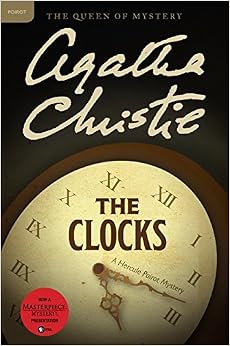
The more I read Christie’s later books, the more I wonder if their reputation is at least partially undeserved.The Clocks is one of her later Poirot novels, so it;s a novel that barely has Poirot in it (which can be either good or bad, please pick one). Most of the plot is told from the point of view of Colin Lamb, a marine biologist who doubles at a spy. The set-up is a solid Christie hook: A typist named Sheila Webb is told to go the house of a blind schoolteacher, who asks for Webb specifically even though Sheila protests that she’s never heard of the woman. Nonetheless, she goes to the house, finds it unlocked, and stumbles on a room where there. Are. Four. Clocks! One is off from all the others, a fact which is completely unimportant. What’s far more interesting is the dead man stuffed behind the couch.
As mentioned, Poirot is barely in this. Most of the book is the investigation of Colin and time-displaced 90s action hero turned police officer Dick Hardcastle. Colin is a fair enough narrator, even if he ultimately does very little. This is problem, because he’s supposed to be looking into espionage, but does very little towards that goal, mostly tagging along in the murder investigation. It’s the normal round of interrogating everyone and their dog, but it still feels more lively than the last Christie I looked at; people have actual personality to them, even if the characterization is quick and dirty. The problem is they lack page time. In Caribbean, the suspects had page time, but felt dry. Here they have more to them, but you don’t get time to suspect them.
While looking into this book, quite a few people complained about how Christie doesn’t live up to the very interesting hook she sets up. I’m glad to inform you that she does. Sort of. It’s the dang clocks that are the issue, you could remove them and end up with not a classic, but what would probably be a good late Christie. They serve no purpose. No, really, they don’t. Even after reading the book, I still can’t understand the reason they were shoved in. Poirot explains it, but it makes no sense, considering how it plays no role in the rest of the plan. I can understand planting that clock there, but Poirot doesn’t treat that as the reason. Really, if she’d cut them out you’d have a far better book.
However, the overall cluing of the book is rather weak. I admit to flip-flopping on this a bit. Everytime I think “Definitely not fair” I come up with a few more clues for it to feel fair, but then when I think it’s fair I start wondering if you could really solve it with what you have, and I have to conclude that you can’t, really. A smart reader can notice the broad strokes of what’s going on, and at least have an idea, but I would honestly be surprised if anyone can come to the conclusions Poirot does in the end, especially regarding the victim’s identity*. You might be able to guess at it, but Poirot has access to resources the reader doesn’t, in this case. Same with the clocks.
The “anonymous victim” idea can be a hard one to pull off, but Christie does well here. Admittedly, I’ll say that you have very little chance of figuring out exactly who the dead man is, but you can make a reasonable guess, and Christie does a good job of playing around with the identity, certainly better than 4:50 from Paddington. She leads the reader along well, and I felt satisfied with the final reveal.
That really sums up my attitude as a whole, “satisfied”. It’s not top-tier Christie, but I didn’t feel like I had wasted my time, like with say Dumb Witness. It’s not the best, and it’s not my first choice for best Christie, but fans should like it. Recommended, with caveats.
*Fun fact! This isn’t the first time Christie did the “anonymous victim” idea. That was 4:50 From Paddingtion.
Wednesday, February 15, 2017
The Obligatory Beach Episode
A Caribbean Mystery is one of Christie's later Marple novels, and already I was feeling a bit of dread going in. I like Christie, like all sane and rational people do, but very few can deny the quality drop in her later years. The fact that this was a Marple novel, which tend to be weaker on the mystery side of things, didn’t help with that. Still, I haven’t read a bad Christie yet*, so I had hopes.
Also I enjoyed Third Girl. My taste is already numb.
As the title states, Miss Marple is currently on a Caribbean cruise, courtesy of her nephew. She’s also bored out of her mind, and stuck listening to an old major ramble about his times in Africa and all that. At one point he mentions having a photo of a murderer on him, and is about to show it when he looks behind Miss Marple, freaks out, and suddenly shoves it back where is came from. Sadly, the tropical air has addled Miss Marple’s brain, and she doesn’t think anything of it until the Major turns up dead from high blood pressure.
Of course, while everyone knows he had it, no one can remember where they heard it. And the picture is gone.
Now, JJ at The Invisible Event took a look at this book, and did a post about nostalgia, Christie in her old age, and many thematic things, which is good and you should read. It also gives me an excuse to focus on the mystery aspect, which I’m fine with.
The main problem with the mystery is that Marple does very little in the way of investigating for half the book, only seriously getting involved after the obligatory second murder. To be honest, it doesn't even feel like her investigation accomplishes much, as little of the information she learns is important to solving the case. I think like one conversation is actually useful, in the long run. At one point, we learn that two characters conspired to poison another in the backstory. Do we learn this from Marple’s tireless investigation, or at the very least intuition? Nope, we learn it in third person narrative, and it proves to be of no importance to the plot.
Speaking of suspects, they’re...there. A mix of couples, nothing much interesting to say, barring Mr. Rafiel, a cranky old man who proves to be both entertaining and interesting. I’m not one who argues that Christie used 2-D characters, but the suspects here remind of The Body In The Library, mainly how everyone was more or less cardboard. The set-up off the story also limits the potential suspects, and while Christie makes a valiant effort to call into questions what we “know” to extend the net, it feels strained, especially when you consider we get this discussion almost halfway into the book.
Even the pure mystery aspect feels, perhaps not weak, but easy. I can’t imagine what goes on here challenging, say, Poirot for more than a day**. I read in A Catalog of Crime that this is more or less a short story as a novel, and I agree with that. It feels like a short story, from the lack of suspect focus to the more minor mystery to the way it’s resolved. The clue that breaks the case is a simple bit of reasoning, more suited to the shorter form. The culprit is also easy to see coming, thanks to a third murder that more or less gives everything away. And another….aspect that I can’t say without spoilers. It’s the sort of information that the author is assuming you’ll forget, which is fair in a 800-page beast, but not so much in a 200 some page book you can read in a few hours.
In spite of that, I still enjoyed it, to an extent. Most of the flaws I mentioned didn’t hit me until after I was done reading, so it was at least able to maintain plausibility. I attribute most of this to Christie's skill at plain writing, a skill all wannabe (and actual!) authors would kill to have. I would know. The narrative keeps moving, and it all passed by so quick that you don’t notice the flaws in the set-up until you’re long past.
All in all, slightly below average Christie. Of course, “slightly below average Christie” is still better than most, but nonetheless, this is Partly Recommended at best.
*except for Dumb Witness, and that was more boring than anything.
** This comes with the disclaimer that I expect two different detectives to have very different styles/types of cases, it only makes sense.